Is this BLOG an experiment? I doubt it. It’s not a reasonable, predictable space. Words can be heavy. Stones, they were called. How to love them?
A place of pleasure, that’s my goal. Encounters and exchanges about art and life. A selected group of people will come and play the thinking game. They will send their thoughts by e-mail. We might be read by the global village. Let’s give them pleasure! Let’s learn to be light. Fleeting and temporary, at least for one year. Personal, fearless, bringing out uncertainties, pauses and hesitations, conflicts and doubts. Most of the artworks reveal idiosyncratic states of mind that are not allowed to writers: no smoking in the toilette during the flight! Unless they are poets.
I was an Eighteenth-century philosophy scholar who turned into a journalist and a maker of hand-sewn books. So my hands give the books a body as the secluded princesses of the old tales, making their lovers’ body with flour and water. None of them have a beating heart. Lack of love makes me sick. Lack of confidence, same effect. Plaintive commentaries about climate and institutional collapse are a black mask on my eyes. Reality is painted black. But The Arts keep me alive. Meredith Monk sings without words, only voice and feelings. I wish we could write like she sings.
No yes, no, I like, dislike, no evaluations. Intelligent kindness. No aggression nor rivalry. Reading, writing, “an exchange of desire becomes possible, of an enjoyment that was not foreseen. Games are not done, let’s play.” (Roland Barthes) Wind and earthquakes shake our landscape. Los Angeles is luminous in the middle of April. We can wear the on-line dress, all the possible colors and shapes, because ideas have colors, if someone cares. The kite needs hands holding the thread as well as the winds and the sky; it needs tension, inside and outside.
“I play them on a blue guitar / And then things are not as they are. / The shape of the instrument / Distorts the shape of what I meant, / Which takes shape by accident. / Yet what I mean I always say. / The accident is how I play./ I still intend things as they are. / The greenish quaverings of day / Quiver upon the blue guitar. (Wallace Stevens)
CINDY SHERMAN, Untitled Film Still #65. 1980 Gelatin Silver print
Expanding Fields :
MOCA’s Collection 1940s-1970s – Summer 2026
Stepping out by Rosanna Albertini
It was not so long ago. About 40 years? Half of my life. Contemporary art pushed philosophical thoughts, academic career aside and became the center of my work. Time is slow if nothing changes in life, becomes a storm if a person steps down the stairs like Cindy Sherman’s figurine, wondering if really is she turning her back to the walls of history, books and sacred art that dominated her country. I was craving for physicality and the taste of the present. Understanding will happen, at a certain moment, I told myself. Or not. Let’s try. In my first review of two museum exhibitions for an Italian newspaper, L’Unità, the piece was written as if having the same tactile experience of a snail sliding on the tables, bundles of branches and igloos by Mario Merz. To shrink in the scale of a small living animal cleans up terrors and uncertainties. It was my first attempt of opening a new mental space and learning from meeting people and artworks. Viktor Shklowskij and Gertrude Stein had paved my way with revelations about writing and making art. Many more followed.
Forty years after, after descending the steps at Los Angeles MOCA, the art pieces selected from the Museum’s collection filled my mind with the same emotions that had steadily transformed me in the first place. No regrets. Two years working in Paris and in French art schools gave to me the clear perception that Europe and the US were different planets. Italian, I was a partial observer distant from both. In the late Eighties American artists had access to French museums for the first time. Naturally, often regarded with suspicious attitudes. First time for Turrell, Donald Judd, Bruce Naumann, Mike Kelly, the minimalists, conceptual artists. American video art, instead, was well known: Dany Bloch, curator at the Musée de la Ville de Paris, had been the first in Europe organizing exhibitions of body art and video art since the Seventies.
Yes, you might be impatient, but this is not a review. I wish I can bring here all the excitement, curiosity, and the passion many of us had for exploring an enormous banquet of arts challenging a traditional and dusty cultural mentality that exposed many of us to the public doubt about the appealing of the ‘new.’ In Locarno (Switzerland), after watching the very first presentation of Art of Memory by Woody Vasulka, I was sitting with my poet friend Luigi Serravalli, who lived in the Dolomites. He jumped up in all the highness of his angular body, loudly announcing: “We saw a masterpiece!” It was a sort of gold digging.
Sometimes my editor -I was correspondent from Paris- whispered to me: are you sure these installations, computer and video art, really exist? She was right, such a deep separation from daily routines, but the same was true for contemporary art in Italy and elsewhere. Piero Manzoni as foreigner as Woody Vasulka and the Fluxus people, also for me, before the break. Still, the most diffused common sense was that contemporary art was nor ART. I could reassure my editor telling her that Nam June Paik’s robots, in Paris, shared the same room with the La Fée Electricite´ by Raoul Dufy, 1937. I’m not sure the present is different. Around the living artists and their works there is a small tribe. I was born in it, as my grandfather was a painter, I will never quit. This is a little story from my tribe, once I moved to Los Angeles in the early Nineties.
NANCY YOUDELMAN, Leaves, A Self Portrait, 1973
Now I see myself as I was then in Nancy Youdelman’s Leaves, A Self Portrait, 1973. But I must reverse the order of the six photos: I arrived covered with dry leaves – words and habits and cultural stereotypes – and gradually found a different way of being Italian, in the foreign city that became home. The major metamorphosis happened while working with American artists: Allan Ruppersberg, Paul McCarthy, Chris Burden, John Baldessari at first, and later many others, Jim Shaw, Tim Hawkinson, Michael C. McMillen, Kim Abeles, Karen Carson, followed by a big number of young and old women artists to whom I dedicated the last twenty years of writing and bookmaking. From Rachel Mason to Simon Forti.
ALLAN SEKULA, Untitled Slide Sequence, 1972
JEAN DUBUFFET, L’écoulement de la ville, 1962
ROBERT RAUSCHENBERG, Interview, 1955
PAUL McCARTHY
With all of them I started from zero. They were names. Or small art books I had found in Paris. As humans, they became generous friends helping me to understand their works in detail. With John Baldessari it was a constant discussion about the art of our UCLA students, struggling to find the way to deviate some of them from projects bringing physical risks for themselves and the others. Art and life were our topic: “Are you serious? me the father of conceptual art?” “They say so.” Better talk of the pilot flying over Brazil, throwing cookies into the jungle. John’s self irony never ended. He is a memory of laughing, kindness, smart ideas and openness. No problem to use the image of one of his Junction Series: Two Landscapes, Birds (with People) and Soldiers (At Attention), for the cover of one of my early hand-made books.
JOHN BALDESSARI, Concerning Diachronic-Synchronic Time: Above, On, Under (with Mermaid), 1976
JIM SHAW, Untitled, 1079
GREGORY WILEY EDWARDS, For the Ashes of the Seven Headed Cobra, 1975
It was surprising to be asked to work with UCLA students for who I was, free to express my reaction to the artworks and help them to be themselves at the best in their projects. The same I used to do with my philosophy students in Italy. Paul McCarthy was the best listener of graduate students. To be with him during the visits was a pleasure I didn’t forget. I could continue forever…. on my side, there was, there is gratitude. For the freedom to write without obstacles, and discovering a little more of myself through the work. With Mark Rothko, I would say I’m not interested in style or aesthetic, “I’m interested only in expressing basic human emotions.” (p. 119 MR, Writings on Art)
The Rothko’s pieces on display at MOCA contain the artist’s passionate expression of clarity and the eye of Giuseppe Panza, the collector who spent years in the US observing and trying to understand Minimalist art in America. He bought them but, in the end, gave them to Los Angeles MOCA. Europe is not yet ready for Rothko. I’m glad they are here, I’ve locked them in my mind.
Let’s read Rothko’s words in 1949:
“ The progression of a painter’s work, as it travels in time from point to point, will be toward clarity: toward the elimination of all obstacles between the painter and the idea, and the observer. As examples of such obstacles, I give (among others) memory, history and geometry, which are swamps of generalization from which one might pull out parodies of ideas (which are ghosts) but never an idea in itself. To achieve this clarity is, inevitably, to be understood.”
I add some other images of the MOCA’s exhibition with no intention to explain them. Each of them irradiates stories and feelings, is art and life and a landscape of ideas I’m glad to revisit with love. I give to Robert Musil the task of finishing. It is from him I learned no to be scared of the infinite network of emotions on which ideas are never at rest.
MARK ROTHKO, No 9 (Dark over Light Earth/Violet and yellow in Rose) 1954
MARK ROTHKO, Purple Brown, 1957
“To love something as an artist, means to be shaken not by its ultimate value, but by a side of it that suddenly opens up. Where art has value it shows things that few have seen. It is conquering, not pacifying.”
“An artist receives the impression that something he has avoided, some vague feeling, a sensation of stirring of his will, is dissolving in him, and its elements, released from the connection in which habit had frozen them. The result is at best mostly an imprecise notion of the process to be depicted, but surrounding it is a dim resonance of spiritual affinities, a slow undulation of further networks of emotions, will, and ideas.”
“What in reality remains fused together like a molten drop is here dissolved, untangled, interwoven — made divine, made human.”
artworks from –some assemblage required– at California Heritage Museum, 2026
and from LA Louver past exhibitions
by Rosanna Albertini
Iwill never say “ in my opinion” as everything I say or think is nothing else. Therefore, in my opinion, poets {and artists} operate an essential function because, outside of life or history, they synthesize their meanings with a language of emotions, sensations, intuitions, placed in the infinite space of fantasy. The innermost language we are not able to use.Alberto Albertini
Alison would say her figures, sculpted or painted, mark the edges of the human experience, bringing us where the spirit is. I have other words on the tip of my pen, like her mind’s power of transformation, mostly working in a pretty unique research field as an artist: the women body. Alison says that her hands have a mind on their own… oh, words are like the hair quality : straight like spaghetti, curly, thin, they are shaped by what the brain has become in each of us in years of practice, not different from breathing. The heart modulates their voice. It’s probably true that Alison’s hands have also a heart on their own.
Let’s look at the few early pieces recently revealed by the California Heritage Museum. They were made in the early Eighties. Small, from 8 to 12 inches. Their soul is so palpable that emotions spread out from your entire body as a viewer, even in front of their reproduction. Little hands from my eyes do embrace them.
ALISON SAAR , Untitled, circa 1981-82 10″ x 10.5″ Mixed media Cortesy Trotta – Bono Contemporary Photo RA
ALISON SAAR, The Prize Fight, 1981 8″x 8″ Mixed media and tin Courtesy Trotta – Bono Contemporary Photo RA
ALISON SAAR, King of the 88, 1982 7.5″ x 8″ Mixed media Courtesy of Trotta – Bono Contemporary Photo RA
Thank you Alison non only for making visible and tangible some intense moments of human life, miniature portraits, but also surrounding them with a fragile, ruined, irregular buffer space. Not a frame really, a shapeless landscape still covered with shreds of stories around the boxing square, the window, the music room. Not the data, the facts, no objectivity. Only art. The artist’s brain, her hands brain shaping, cutting, sewing, painting, assembling the fragility of objects with the energy of her feelings. Every stitch is meaningful, beauty is beyond forms. Beauty is sharing.
Time has become still in these icons. If there was a past in these tiny lives, it is absorbed into physical details reassembled by the artist. The girl at the window emerges from layers of found papers and printed flowers, visible and silent. She gracefully offers her heart as a flower between her breasts. Locked in herself, she looks in front of her not knowing if hope is painted blue for her in the sculpted space, green on her window frame. Her identity is not necessary. “Creation herself is supposed to allow access to a mystery”. “Time, instead of renewing our states of mind, our qualities, essentially is a new birth”. {Emmanuel Levinas} Which every piece is for this artist.
It is probably pointless to speculate or linger over the artist’s intentions, her abilities. She is completely taken by the mystery ’s call.
I’ll try to translate and rewrite here a thought, almost a fantasy written by Emmanuel philosopher, as it gives us a tangible sense, a sense for the mind, of the deep work Alison Saar has developed through all her life as an artist, recreating the feminine body as a threshold to infinity.
The notion of ‘feminine’ breaks free from control, even from the history power that excavated fears and anxiety in women veins, and give them cotton flowers pushing at the end of their hair. She doesn’t run toward the light, light emanates from her. She prefers not to be encountered, hiding the most, converting eros into the power of giving birth. She is the quintessence of alterity.
{Every arbitrary alteration or mistake is my responsibility, RA}
ALISON SAAR, Uproot 2023 Wood, ceiling tin, and cotton 32 x 10 x 9 in Courtesy LA Louver. Photo RA On the wall, from far, Hygeia 2022 Found brooms, sea shells, glass bottles, indigo dye, charcoal, and acrylic on found seed sacks, 90 x 80 in
Alison Saar’s artwork symbolizes every woman’s story, her statues show so many different skins, so many colors and textures, they defy gravity, their hair becomes a solid deer antler to protect the head when they are hung upside down, a rope around the ankles. They are solid, monumental, branches push from their bodies as if they were trees. Birds sit on the branches but they don’t sing the woman stories. Maybe Rhiannon Giddens could.
I wish I could listen to the songs chiseled on their bodies by Alison’s fingers, when branches of milk become roots lifting the body up, toward the ceiling; when a scar reddens the palm of a hand (Scar Song); when her sculpted figures stand like warriors. Not invulnerable, no, yet they talk and sing to our senses offering “sensibility, the door to imminence, of always impending change.” {Paul Valéry}
They are more trees than dancers. Need a place. Need ground. History indeed wrapped a skein of threads around their ankles, sometimes history is simply daily life growing children: a garden of deer antlers around the feet, for years. Do you remember the day your daughter left for college? When it happened to me, and it was my stepdaughter, I had for some time the sensation I was shorn off of a leg. Rouse, 2012, is a masterpiece. Gertrude Stein would agree. Can we cry together?
I don’t know other ways to tell Alison my gratitude.
“Non dirò mai “a mio avviso”perché tutto quello che dico o penso lo è. Dunque, a mio avviso, i poeti svolgono un ruolo essenziale perché, al di fuori della vita e della storia, sintetizzano il significato di queste cose con un linguaggio di emozioni, sensazioni, intuizioni, collocati nello spazio infinito della fantasia. Il linguaggio dell’intimo che noi non sappiamo usare.” AA
When my younger stepdaughter was a child, out of the blue she started a new social practice. Bringing straight forward her little arm, she was offering her hand to each new person she met, saying: “Hi, I am Hannah Kirby 5.”
Alberto could do the same. “Hi, I am Alberto 99.”Our written conversation and collaboration about the arts is still on. He sent me the four lines I quote here about three weeks ago.
BIBLIOGRAPHY
Paul Valéry, The Outlook for Intelligence, Bollinger Series XLV, Princeton University Press, 1989.
Jorge Luis Borges, In Praise of Darkness 1975 (my interpolation, ra)
At 4 am today, July 29, she stopped breathing.
Last night I felt oddly awake, thinking of her incessantly. Playing solitaire, as she used to do when she couldn’t sleep, I kept my feelings quiet, alert, as if waiting to hear something.
Today I am transpierced with needles of energy, the same I felt when the important people in my life disappeared. The opposite of nothingness. They are all with me until my last breath.
My Peter husband and I went to see her a few days ago. A beautiful color on her skin, regular respiration, she was so beautiful that I couldn’t resist drawing a quick portrait of her long death, that was longer than a month. She kept herself alive as long as possible, it was her plan. A wish she told me during one of our visits to her parents graves, in the small Brentwood cemetery.
Time of this visit was the last present she gave us, the work of death was real yet peaceful, acceptable. The noise – of every kind – outside Simone’s room had disappeared. Confusion, irritation, fears, all gone.
Peter and I were calm and happy. The feeling lasted a long time after. It was the same steadiness, the same contentment I discovered every time I spent time with her, for many years. She was paying attention to everything, asking for the same attention, Simone the rare, precious human specimen able to make you feel who you are. In your constant movement and change. Reality is not in us. Reality is us.
History, news, they only have a face that we give them, remembering objects, colors, sentiments and people. Simone’s performances, her written words, her drawings and the movement of her body, often with friends working with her, keep us in the loop, in the dance of questioning and shaping relations, not even trying to give a final, straight answer. Humour and and glimpses of seduction are part of the dance.
“Last night / I dreamed / two ravens / singing their hearts out” she recently wrote over a small drawing suggesting the singing birds. She gave me the drawing. I give her mine – who knows? – maybe her heart was singing, behind her closed eyes.
June 30, am e-mail from Simone (probably dictated):
Dear Friends,
I did not properly thank you and I want to make up for that. It was wonderful to be so honored. I’m so sorry I did not complete my part of the project. If you’re not on this list then you should be. I think you know who you are.
I wish you a full, creative life.
With love,
Simone
Simone Forti & Batyah Schachter 2010 Still from video
For readers who never met Simone, I bring a text published in 2006, in Unbuttoned Sleeves.
PS. I’m sorry, I am the War was not written by Simone, my mistake in the emotional storm of these days. I pick another text, this time by Simone for sure, from the same collective book. I see now, better than in the past during the live performances, what a deep synergy pervades the different voices in each project. Reading resonates more than listening. The text I add here brings back the beginning of a family exile. A journey to Switzerland, by car. pp 45-46
Everybody is packed in tight. We are in the car and even my big sister looks tight, her face. Our nurse. And mother has a big belly. The border, la frontiera. The men in uniforms and guns, how do I know what a gun is, I can smell mother. Father looks happy, free, excited, the guns are blue-black father wishes the officers a happy holiday our skis are on top of the car. We’re pretending. One time back home in the street father was walking and thinking and whistling and he heard a man laugh, looked up and realized he’d been whistling “Bandiera Rossa,” the Communist anthem, he could have been picked up for that. We were rich but I had to leave my toys and I knew I’d never see my toys, the tea set, the big monkey, again. But I had my little doll. I could smell mother sweating in the cold car and she smelled like those black guns and father’s voice to those uniformed gunmen was too excited. My sister. I was where my big sister was I was there before, and I still was there, and everyone spoke German and mother could speak German too because she was a great lady. Ah, the baby. What a name, Nicoletta. As fancy and delicate as she was. I touched her, her tiny fingers. I had my African doll. And I made a fort out of our suitcases.
I am the War
by SARAH SWENSON
I am the war. I’m here to explode your bodies and poison your soil. Separate your mind from all reason, same as mine. I need to get you out of my way, my way makes right with might. A means to an end, “the method of kings.” He stands on his pulpit. Let him stand in the middle of Baghdad, let him stand in My Lai, let him stand in Wounded Knee. Let him keep speaking with a forked tongue, and see if the words change then. A coward by any other name. He is the war, blind and arrogant, senseless, and stubbornly righteous. Will he hang himself? We hope, hope….but hope fades daily, hourly. Are we the war? Our meager thousands, stamping, shaking, marching in futility and resignation. Where do we go from here?
Simone Forti and Batyah Schachter performing at The Church in Ocean Park, in 2010 (video, fragment)The performance was without public. Simone had asked Peter to make a video of the complete action.
Video by Peter Kirby, 2010
SIMONE FORTI, TERRENCE LUKE JOHNSON, SARAH SWENSON, DOUGLAS WADLE, Unbuttoned Sleeves, Beyond Baroque Books – Los Angeles, 2006
RAVEN SANCHEZ, Familial Feeling(ruega por nosotros), 2025. Wrought iron spiral staircase from 661 Findlay Ave., concrete edging stones and rocks from Lorena St., and shells.
by Rosanna Albertini
The presence is the art piece. An odd display of images, objects and natural grains of sand, of tobacco, dry peppers and rocks, only justified by their physical separation from a story of disappearance. Art becomes a theater of phantoms, tangibly and vividly bringing our mind to the place where a familiar existence ceased to exist, moved out from the artists’ lives. The grandparents’ passing, and their home in East Los Angeles sold after fifty years of family life, for Raven Sanchez. Her husband’s death for Senga Nengudi.
SENGA NENGUDI, Ellioutt – Love, Photos by the artist taken in the 1990s, Installation 2026
“Shall we meet the pure nothing? After such imaginary destruction, what remains is NOT some things, but the simple fact: THERE IS.
Absence of all things comes back as a presence: as the place where everything sank, like a dense atmosphere, like a fullness of emptiness or the murmur of silence.
After such destruction of things and beings, there is ‘the field of forces’ of existing, impersonal… the fact of existing imposes itself, when nothing is there anymore. It’s impersonal like ‘it rains’ or ‘it’s hot.’
Solitude is an absence of time…
She is the companion of our daily existence haunted by the matter.”
My free collage of Emmanuel Levinas thoughts, in Le temps et l’autre, Paris, 1979, RA
Asì Sea/So Be It, by RAVEN SANCHEZ, contains a selection from 200 papers rubbed on the skin of the house, and some trowels holding dry peppers, rocks, MX and shells as symbols of daily life as a continuous sharing: Family Feeling, 2024-2026. Art at the best. THIS IS THE FIRST EXHIBITION OF RAVEN SANCHEZ IN LOS ANGELES.
Asì Sea, So be it, Così Sia. Raven’s prayer. My prayers in Italian and Latin during childhood.
So many catholic prayers end with these words. Acceptance of what we don’t understand and is beyond our personal lives. Infinity of the loss, in the texture of reality, joins the infinity that the art pieces suggest, as if they would open the door to a place which is not us. And is hard to conceive, in a constant fight against all the strings of utilitarian logic, reasonable or not, driving humans every day.
I found it beautiful that both these artists display what their experience gave them, images and materials of daily living, what hands can touch and the eyes have seen. Knowing the limits of physical perception and loving it anyway. Most importantly, giving to their hands, (joined by other family hands in the case of Raven) the task of the last illusion: to touch the edge of an undefined territory where erasing and obscuring hurt the desire of those who must go on, dressed with solitude.
In the absence of time, images remain just what they are: hand-made papers rubbed with wax pastel to capture the movement of the builder (the artist’s grandfather) on the surface of walls, the grain of the house’s surface outside and inside. (Raven Sanchez)
Three photographs for Nengudi: her naked old man horizontal in the tub, the long dreadlocks, wet, around him like roots released by his head, is a human trunk floating in time, looking throughout life from beginning to end. The three different takes of the same image become a classical triptych contained in a curved line drawn by her on the wall, a large gestural arch embracing them with love. Sand mixed to decorative motifs made with tobacco, from the last package the man did not smoke, add a simple, realistic touch, like in Mexican altars of the day of the dead.
I frankly don’t know if art is a conduit toward the spiritual, as the exhibition declares in the general presentation. If you feel it, yes, but not necessarily. What makes artists’ lives and work an irredeemable outer world, unreachable at times, is also what allows such a fragile land to hover over everybody’s lives without touching them, just showing somewhere else: human alterations of reality.
Asì Sea, So be it, Così sia. This prayer that can be gentle, and meaningful, also outside of a religious universe.
PAUL WINSTANLEY, Walkway, 2026 oil on linen 72.44 x 90.55 inches Courtesy 1301 PE
1301PE Los Angeles March 2026
“The images, the paintings, are always extraordinary; the reality, even when similarities remain, bears almost no relationship tothem.“
From: Paul Winstanley, 59 PAINTINGS, London, Art/Books, 2018
Here I am, as the painter wrote, “the artists gets out of the way and leaves the viewer where once he stood.” I know Walkway is an image he reworked many times, each time a different painting in sync with a new state of his awareness of what he is doing. I use the present, as a sort of absolute time, separate from the fullness of things in which we loose the sense of our most intimate perception, and time steals our days. As I stand in front of the painting something from inside me is sucked in toward the silence of the white square at the end of the tunnel, so intense it is scary. The painting is, not the real physical place. Other humans have been there and marked their presence in graphic signs. The skin of the tunnel bears tattoos. Only in the painting they are indelible. But an un-human, vaguely pink-brown fog fights with the clarity of the white end. Forget reading. Only my soul can slide through the artist’s mental fog, and mine, maybe ours, in this damned 2026, where reason has lost her way. “life seeps in unintentionally, subliminally” (PW)
PAUL WINSTANLEY, House in the Mountains, 2025 oil on linen 87.01 x 60.24 inches Courtesy 1301 PE
‘Surface, translucency, light and space are all as one; they are indivisible. … a pure idea of the physicality and illusion of the painting.” (PW)
On the wall, in the gallery, “ the subject of the painting has ceased to be the walkway or the trees but was instead the painting’s own mediation of these things.” (PW)
What I write here makes sense when we are in front of the painting, the 87 x 60 inches of a window whose semitransparent curtain filters the outside scenery and remakes it intensified on the floor. My brain, at first, was seeing nuances of gray as the dominant colors. My eyes were mimicking the curtain, tricky as they are. I stayed still for a while, waiting: and colors come to me. As if the painting was waking from sleep. It was such a wonderful sensation that I liked to believe it was true for a second, a magical mutation. The one who was asleep was my brain, slowly making the colors out of the waves of light hitting the receptors at the door of my eyes. I am old, no surprise. You wrote it at page 94, dear artist, “ Self-irony, or knowingness, is always present as part of nostalgia, even when we are tempted to think it is not.”
The viewer needs it as much as you. I continue to see the light blue and the pink in the sky that gives to the painting a vaguely luminous area taking off from the top of the trees, as if the end of foliage was a landscape line. The profile of earthly creatures. I want to be a bird in that sky.
PAUL WINSTANLEY Stairwell 2, 2026 oil on linen 64.96 x 43.31 inches Courtesy 1301 PE
“My paintings consist of the color they need to be, for their own purposes.” (PW)
That’s a place that only exists in its painted form. Fabricated from photographs. Anonymous, enclosed inside a building, giving room for stairs or elevators, the place nobody pays attention to. Worse, the unidentified place in which humans are usually anxious, moving with haste, they can’t wait to reach some where else. The painting instead has erased all the unsettling feelings. It’s clean, almost soft. Green and pink diluted by light are the colors it needs to be. To be alive with hopes, expectations, angles and surfaces that bring to my mind an idea of transfiguration of architectural elements into a place filled with gentleness, silence, vertical breathing. Is it an organism? Really I don’t know why, the image of an unfolded body crossed my neurons.
PAUL WINSTANLEY, STASI, 2026 oil on panel 17.72 x 23.62 inches Courtesy 1301 PE
Smaller, surprising, in this almost romantic sequence of curtains in an oblique line, hiding more than revealing both the outside and the inside, the painting is a physical questioning, an oblique line of protection: dangers might be either inside or outside, please curtains, save us from harm. Veils are delicate, beautiful, seductive. Upper and lower space are two different dark browns, as if the earth was feeding them with strength. We can merge within the folds, and disappear.
“Focus on the mediation of experience rather than experience itself may, more properly, represent the world in which we now live.” (PW)
PAUL WINSTANLEY, Bathroom Mirror 2, 2026 oil on panel 17.72 x 23.62 inches Courtesy 1301
Desperate splendor of severed flowers and branches, before they fade and die. A quite penumbra, like in a house with the curtains closed in the afternoon, brushes petals and leaves giving them a mid color, temporary, and smooth. In the painted mirror the most unrealistic reflections recompose the scene, once more enchanting with colors. Images are pushed into the foreground by a steady barrier of brown and blue. Trompe l’oeil, it’s fun. Flowers and leaves recreate their own artificial environment. The artist reads their wishes and makes them happy.
“The painting is a picture of something, though of what is not entirely clear.” (PW)
Reading your The Bear in The Mirror for the second time
I stopped on page 77: Stories
in life
do not exist.
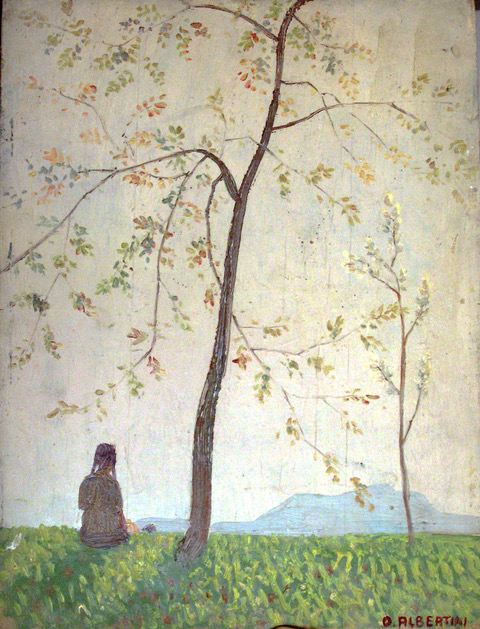
They need words to exist, people and places and pages, of course. But in that case, are they life or art? Let’s be ambiguous; for your birthday I send you again art from my family, by grandfather Oreste. I come from that garden, around it were fields and mountains beyond the lake, in Switzerland.
Grandfather painted me near the petunias. As I am made of time, strange intangible word, I moved out and far. Also, I never left the garden. These paintings keep me anchored.
Stories are told to my eyes by the light sweeping the small scene, almost burning the mountains’ tops during the sunset, and by each stroke of color. The act of painting for grandfather, and for me so very often making drawings next to him, were living moments grabbing an image from the passing time. To make an image out of love. Fighting, holding the power of changing not, and forever being. A strong circle connects me to these images as if my life could go back and forth jumping beyond obstacles.
I wish I could walk out of the painting and give you a petunia for your birthday.
Is white ok?
With love, Rosanna
Two paintings by Oreste Albertini, 1947 for the garden and unknown date for the landscape.
Urban life is brought inside, reshaped, regrouped. In the huge abandoned space, the shelves filled with artpieces overlap in the distance becoming a sort of inner landscape, as if all the moments of seeing and sharing we gather in a day had been brought together, transformed, and made surprising. It’s not only disorder. Art is gently arranged for the public viewing. It’s a piece of choral music plus confusion, questions, doubts: Am I right being here? Can I stay? And the old 99¢ Only Store building becomes a fragile castle for dreamers.
Integral to chaos are the threads of the future. If only were we able to grab them and spin them in our mind, instead of crushing them like cigarette butts on the floor. Time is encrusted in our organs, centuries of ruins have covered brilliant civilizations, death and birth are a nuptial nod over the human lives. Messy. The 99¢ Only Store died, a group of artists from San Francisco brought back the space to a week of life. In a place that smells of abandonment, art becomes a phoenix regenerating from the ashes: a portrait of urban life made by many hands, many different minds, cultures, beliefs … walk through until you lose your mind, until your heart beats stronger and a big smile moves your lips. It’s all for not being lonely, self-sufficient or dismissed by the need of order.
Barry McGee marks his own presence with colored geometries scattered among the large population of artpieces without disturbing them. Vivid and silent, his images could expand like fractals, they don’t. Thoughts are organized by hand, limited by vertical and horizontal edges. They merge into the surrounding collection of objects filled with sensitivity, refusing evaluation, announcing their presence.
A rational choicekeeps the exhibition together, hovering in the air, invisible, out of touch. It’s calledequality. Along with its essential companion, the feeling of equality.Past and future are neutralized. We stay in the present and we can embrace it, enlarge it, and drink the air in front of us.
an on line exhibition presented by LA Louver Gallery, Los Angeles, February 2026
“whereas life or reality confines itself to proliferating within the instant, the mind has spun for herself the myth of myths, the undefined element of all myths—which is Time…”
Paul Valéry, 1928
All my thanks to Paul Valéry’s spirit, who assisted me and helped me to decipher Matt Wedel’s plates. All the quotes are from ’A Fond Note on Myth’.
A FEAST FOR THE MIND
by Rosanna Albertini
A dinner for a hungry mind, a forest of branches longing for tentative movements, the same efforts of a vine that elongates her limbs to embrace a dead tree — secretly wishing to bring him back to life?
Let’s blend gradually into our “natural depth and darkness” a place in which the mind looses clarity and gives up, for a while, with problem solving, efficiency, organizing, planning, or looking for fast revolutions, faster political changes, misled by illusions. As if dreams could have a practical side and could walk on a carpet of money plus will to become reality.
In the penumbra – as the curtain is down – the mind forgets how to be busy, then walks on the irregular streams of the imaginary world, only guided by uncertainty, mistakes, hesitations and an infinite number of possibile images or words. No explanation is required, yet the mind sees far, ahead and behind, and is cuddled in between, resting on an impossible, soft image of the present — something that doesn’t exist, a transparent cloud.
From there the mind gives birth to events, stories, situations setting on the table “a candid cosmology,” and more and more naive images nourished by a need of broken causes, human stretches of time, and simple actions: if our heads share a field of blue, shall we call it sky or water? The image doesn’t know. Because, it’s a matter of language, either made of visual signs or words. It is just story-telling; a true intuition sometimes, or a shredded cloud.
“All our language is composed of brief little dreams.”
Matt Wedel is so familiar with the almost natural transformation -looking natural- of heads and vegetal bodies into ceramic creatures, that I’m sure he doesn’t decide what he is making. So many myths are in him, in the garden which is his body, where every part interacts incessantly with near and far parts, with lack of separation between the busy chemical activity of the cells, the movable forest of neurons, and the constant request from outside to open the doors of the mysterious organic machinery, that he has to react creating new myths. Children do it incessantly, with no restraint, before writing and reading educate them to a strange unnatural style: the linear universe. Masters of brief little dreams as they were in the beginning, they quit the imaginary island where it was hard to distinguish dreams from reality.
Rational clarity kills the myths. And “the fauna of vague things and vague ideas wither away… Myths decompose in the light spread by our body combined to utmost degrees of consciousness.”
Apparently, such a disaster doesn’t happen on Matt Wedel’s plates: ideas remain vague. The upcoming risk of disappearance seems incorporated in the way stories are painted and cooked. It’s a physical process. Stories are not easy to decipher. The figures’ edges are soft, flowers are no more than spots of color. The naked cavalier is a white ghost on the back of a goat lost over an unfamiliar site of emptiness. Two women in conversation are on their way to dissolve among the flowers that invade the plate, while both women and flowers start vanishing under the power of the light. Red fruits on a tree aren’t sure where they sprout from: a tree or a head?
My favorite plate (also Dominique Moody’s favorite) is a pre-copernican cosmology: the universe is flat. The long curve of hair woven into a braid, in continuity with the curve of vapor from a boiling pot, are a circle of fantasy flowers around the young girl face to face with the beast. (First image, under the title)
Another girl? Another plate. Maybe she is not, a bow is on her hair, but the body is brown, soft with fur like a teddy bear. The packed non-geometry of stones behind her tells a story of undefined emotions, there could be danger in the air.
Once more, details are canceled by light in the plate of the woman giving birth. The contrast is striking between the figures of fear around her, even in her arms, and the placid resilience of her body. Upside down pots become masks. They are incapable to close their mouths. Red, brown, bloody. From the depth of time to the physical depth of the major event in human life. I do remember. I loved to keep the nine months of pregnancy a mystery revealing some of itself at each day. I refused to read books or ask for medical details. Little by little I slipped into the awareness of my animal nature, waiting with joy for the miracle at the end. I was kissed by the sensation of belonging to a time without Chronos, bringing to light a new human being. Out of me, she stood in another time, forever separate from me. It was the only moment I knew without doubt that names, identity, documents, are dead leaves. I was one with any living beast on earth.
BIBLIOGRAPHY
Paul Valéry, ‘A fond note on Myth‘ in The Outlook for Intelligence, Princeton University Press, 1989
from Bollingen Series XLV,The Collected Works of Paul Valéry, Edited by Jackson Mathews Copyright 1962 Translation by Denise Folliot and Jackson Mathews.
This selection was first published by Harper & Row, Inc. in 1963
LA LOUVER Los Angeles – January 2026 Photos: Matt Emonson
I am a woman, my woman.
I am a girl, my girl.
I am woman, the woman.
I am girl, the girl.
I know how to work.
My feet work.
My hands know.
I am girl, my girl.
I am woman, my woman.
You made me woman.
You gave me woman.
Woman of the Flowers.
Mother of the Sky.
Woman of the Roses.
Girl of the Roses.
Flowery Woman of the Roses.
Daughter of the Rose in Bloom.
You gave me woman.
You gave me girl.
You took a girl out of me.
You took a woman out of me.
……..
You gave me my spirit.
You gave me my death.
You put my soul inside…
—Loxa Jiménez Lopez
Loxa Jiménez Lopez is Mayan woman from an untold time. The legend says that Anjel, “daughter of the Lord of the Caves, whispered in her ear and then, in dreams, showed her the Book with all the magic words to be learned.”***
I imagined Rebecca the painter was not just giving us portraits of flowers. She adds words for each painting, and titles sound like a ritual she started for herself, about herself: the flowery woman. A face surrounded by Gold Hair, wearing a mask of colors from the flowers hidden in her body, blooming from her hands.
Pink Punk Rose — A punk rose starting out like a kid starts out, inexperienced. A flower not yet knowing about her destiny, aggressively confused, spreading fullness and tension. The blue tries to contain the edges, before giving up, becoming lines from the sky.
Dahlia Uprising — The dahlia’s flower is a miracle of geometry. Soft with petals, a head full of hair. The artist brings an inconceivable disorder among the petals, a nervous uprising as if flowers were refusing the vase, trying to go away from the corolla, perhaps asking themselves “why” are they here. Why were they cut off.
Pink Heirloom — Who are they their name doesn’t matter. They are valuable forms. Heavy as if full of juices, ripe to death. So is the vase. The last wish of both flowers and vase was picked up by the artist who suspended disbelief: they float in the air.
Nasturtium Crown — They climb, or fall on the ground. Nasturtium hold all their energy in their colors, they do not raise vertical from stem to stern. As a painted crown, they float in the space missing a surface where to pose, and smile. Except the artist gives it to them, filling the wall with a fan of light that pushes the texture of stick strokes away from oneself, and encourages the flowers to be up, for a while, all they can have.
Blue Hydrangeas — I had them as a child in the back of the house, the shadowy side. Blue and round small umbrellas that stole their color from the sky. In this drawing they look particularly happy, luxuriating in a hat for the lady vase still like a stone, while they play with the light not knowing, maybe, how long.
Afton’s Abutilons — Red lanterns looking down, imperial, full of themselves as they can be. Although, they might shiver inside, and activate inaudible bells, warning about the yellow danger of the table, an alien flatness they cannot avoid.
Preppy Poppy — The starch in their look makes them rigid, or slightly perplexed. Red edges around the petals merge pain into their beauty.
Self Portrait in Green and Red — How vulnerable she makes herself! Yet, to use Eliot’s word “vulnerability was an opening – an ‘entrance.’ Where people were vulnerable was where they had once made room for other people.” Modern people struggled to find a language to “render what is unacceptable about themselves intelligible.” (Adam Phillips) Rebecca Campbell is an artist, feelings and desire are her stem. Images are her language. Not everything can be explained, nor understood. That’s why she lets herself unfold, until touching the ground. She apparently accepts her (our) fate: accepting things that cannot be ignored and cannot be understood. But in the end, green is resilience.
“I am woman, my woman”
REBECCA CAMPBELL
1. Self Portrait with Gold Hair, 2025oil pastel and UV varnish on paper, Image: 14 x 10 in.
2. Pink Punk Rose, 2025 oil stick on paperImage: 21 x 29 in.
3.Dahlia Uprising, 2025oil stick on paperImage: 74 x 49 in.
4. Pink Heirloom, 2025acrylic, oil pastel and UV varnish on paperImage: 19 3/4 x 28 in.
5. Nasturtium Crown, 2025 acrylic, oil pastel and UV varnish on paperImage: 27 1/2 x 19 1/4 in.
6. Blue Hydrangeas for Dot, 2025oil stick on paperImage: 29 x 21 in.
7. Afton’s Abutilons, 2025oil stick on paperImage: 21 x 29 in.
8. Preppy Poppy, 2025oil stick on paperImage: 74 x 49 in.
9. Self Portrait in Green and Red, 2025oil stick on paperImage: 74 x 49 in.
BIBLIOGRAPHY
Jerome Rothenberg, Technicians of the Sacred, University of California Press, 2017 pp. 369-372. For Loxa Himénez Lopez see Incantations: Songs, Spells and Images by Mayan Women, (El Paso, Cincos Puntos press, 2009) a Tzotzil/English version. “The fruit of the work of 150 people across thirty years, these are the first books written, illustrated and put together by Mayan people in nearly a thousand years.”
It was probably my fate to be in Phallus : Fascinum : Fascism. As one of the curators and as an artist, a combination I refused for most of my life. One thing at a time was my motto. But a day comes when old habits stop making sense. I thought I had stopped being a scholar, it wasn’t true. Every inch of my long life is here today tickling my fingers, the ones that write. Only three weeks before the opening in Nov. 15, I received the invitation accompanied by a text that forced me to reconnect with a silenced part of myself: years in which I tried to understand what History is or has been told, mostly invented. Years of swimming in waves of books with two amazing tutors providing help and discussions: Arnaldo Momigliano and Emilio Gabba. A storm of nostalgia submerged me while I was reading Robert Zin Stark’s manifesto. I was inside Borges’ castle without surrounding walls nor center, adjusting my sight to a fog hiding or revealing them like cherished illusions.
This was my state of mind searching for artists to invite. They all appeared in less than a week. They also read the manifesto and followed, as if jumping on a magic carpet. When the whole exhibition was done, filling THE BOX from floor to ceiling with the artworks of 200 artists, the whole gallery became the castle, barely contained by the building. Hard to explain, I felt so good and happy to be in it. I could be nobody. I could not know names and titles of the single pieces, yet it was not hard to enjoy the variety of other reactions to the manifesto, secretly holding everybody together in different ways. The other curators were also a mysterious entity to me.
A photojournalist asked me to point out to him the other curators, so he could take pictures of them. “I don’t know them,” I told him. “But you are a curator,” he replied shouting at me. “Isn’t it enough?” he threw his arms in the air, exasperated, and finally went away. He wanted a center that didn’t exist, like Los Angeles, like the art scene in the whole world.
“We create and destroy with our words” said a young artist in a different exhibition, Made in LA. Let me skip the name. This is not a review. He is someone thinking about the emotions of a flower, and its language. I want to look at the art in the show in a similar spirit, thinking without cages. A dead mother covered with fake jewelry, two enormous black vertical penises, oh, the two towers! A purple cloud cut like a stone, the transformation in fake gold of a plant of corn, a naked artist standing in a wooden replica of his carcass lifting little by little a big, heavy piece of wood positioned as a penis; a cactus trying to scare a snake: “NO ME CHINGAS!” A chair becoming an automatic violinist, a concert for metronomes, a magnified page of the LA Times in which the photographs, one after the other, start moving: the flag, the cars, people. Yes, wonderland, but I’m not Alice. There is a rational choice keeping the exhibition together. It’s called equality. As much as words can still be trusted. And its essential companion, the feeling of equality.
OMG, HOW MUCH I MISS THE FLUXUS AXES, the LIVING THEATER, and BODY ART, the EARLY VIDEO ART and INSTALLATIONS, maybe because they have been the pebbles on the ground guiding me out of from philosophy into contemporary art. The human body was their common catalyst. In our reality so frozen, stiffened in objects supposed to be appealing, with names giving old and new objects a financial validation, this exhibition offers the opposite: a systematic, quiet, elegant proximity of images coming from famous and from completely unknown artists. A large field of drawings, paintings, photos, sculptures asking to be considered for what they are. Known or unnamed blades of grass, an endless variety: a field in the spring before the pesticides. Please forget the rules! Look at them. Be with them. They are alive. So many artist are here that belong to the forest floor of the LA art world. “Inclusion” was not only a word in the manifesto, it’s real. As it rarely happens, the exhibition displays a convinced, beloved, respected notion of equal presences spreading a refusal of hierarchy, a sense of freedom, of lightness. Nobody prevails.
Perhaps my sense of elation will have a short life once THE BOX will dismantle the castle, or not. Every time I ‘ve been in unexpected, exciting situations, not always recognized as “art,” my memory never forgot them. They are in my body, and my fingers can write.
“It is not an image I am seeking. It’s not an idea. It is an emotion you want to recreate, an emotion of wanting, of giving and destroying.” Louise Bourgeois


You must be logged in to post a comment.